Long Term Care is NOT For You

Not just for you . . .Long-Term Care Insurance is also for the people who would take care of you without it.

This is a professional blog.

But this is going to get personal.

I haven’t written a blog post since August. I couldn’t find the words in September. Since my dad’s health faltered to a point that he nearly died in the hospital. Since I struggled every day to help my mom find important documents and pertinent information. He was not cognitively aware or able to help. I had to dig through piles of disorganized papers and discovered more than a daughter should know, frankly. I’ll do my best to steer clear of that rabbit hole. It’s not a fun trip and won’t help anyone. This post is about an insurance topic that will affect every reader, in one way or another, if you or someone you love lives long enough.

Immediately following my dad’s hospitalization, my family quickly realized we were out of our depths and contacted a law firm that specializes in elder care. They have been a lifeline for me and I highly recommend consulting with experts early so that you aren’t to the point of drowning before reaching out for help. Perhaps, you have already made your own arrangements so your loved ones don’t have to scramble behind the scenes. Kudos to you. A thousand gold stars. My husband and I are committed to taking the steps necessary so our kids will not be handed the burden of responsibility for our care. Since they are teenagers, that’s hard to imagine, but long-term care requirements don’t only arise with old age.

[A current status report feels necessary to avoid unwarranted suspense. My dad mostly recovered and is receiving home healthcare after a twenty-day stay in a rehab facility last month. His diagnosis remains unclear, however through this experience, I can testify to the importance of having Long-Term Care insurance regardless of an individual’s prognosis.]
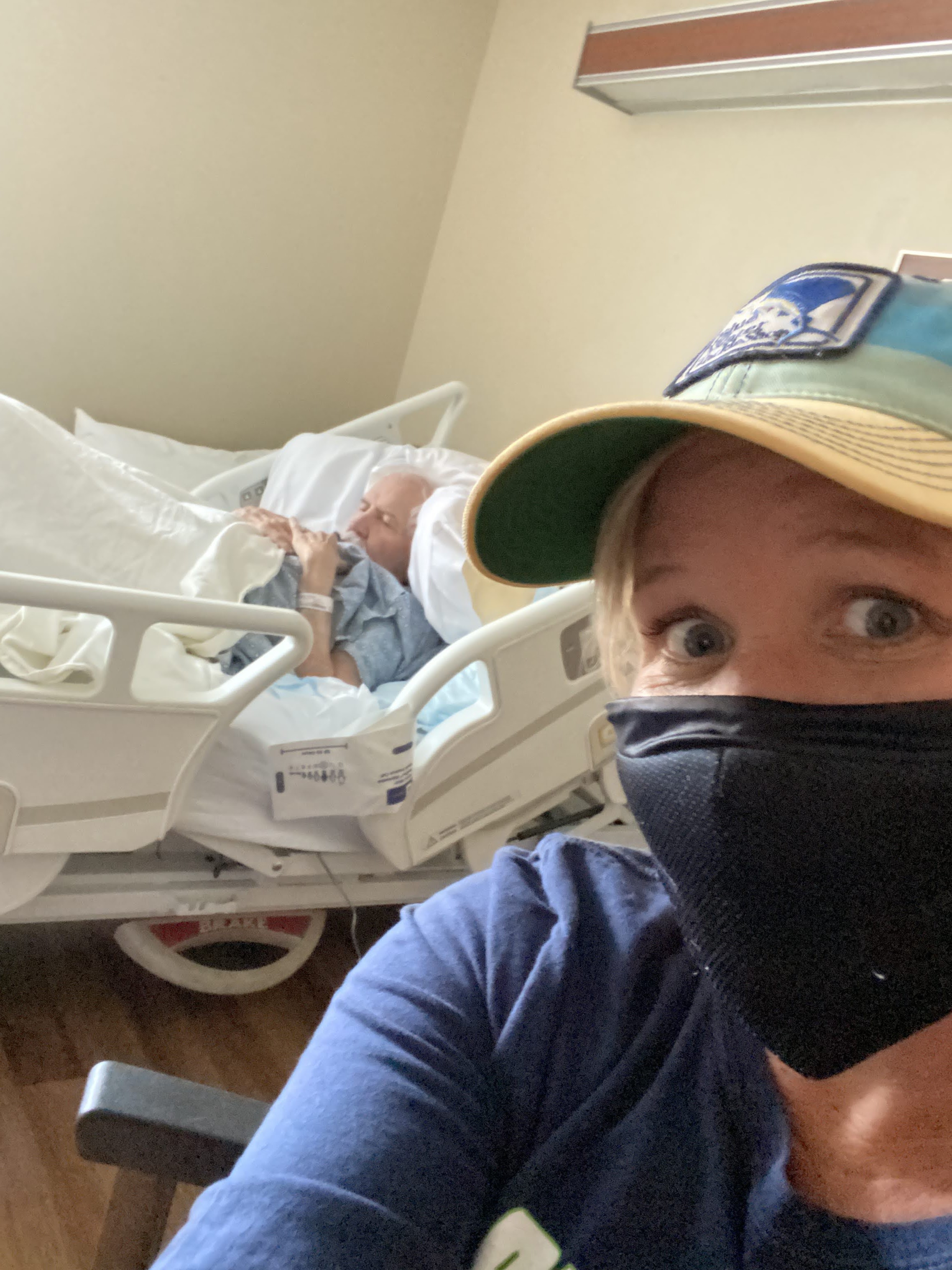
At the hospital with my dad.

No one enjoys taking photos during a difficult time. It isn’t fun to experience the first time around, so you don’t relish going down a visual memory lane later. I feel anxious just seeing the bed, the blood pressure cuff, the bland wall, and my dad lying under a thin blanket in a snap off gown like the one I wore when my children were born. I have this one because I like sending selfies to my teenage kids instead of tediously texting an update: “I’m with Pappaw at the hospital. It’s fine. He’s sleeping. Covid regulations in effect so I have to wear a mask.” Not quite 1000 words, but they get the picture. Pun intended.

We transferred my dad to a rehab facility covered by insurance for at least twenty days. An assessment would be made at the three week mark to determine if insurance would continue coverage. We–my mom, sisters and I–did not know the system and an acquaintance recommended we contact an elder care law firm to help us navigate “the game.” We had a preliminary consultation with a lawyer on Thursday, heard he was being discharged on Friday, registered an appeal on Saturday, prayed on Sunday, and brought him home Monday. The physician believed he was well enough to move on and insurance will not pay 100% for further therapy at that point. The aversion to paying out-of-pocket costs made us move quicker than we should have because if he had stayed, then he could have been transported to either assisted living or a nursing home. Since he returned home, he would not be considered at either place without going through hospitalization again. I’m not sure if it’s strictly Covid-19 protocol related, or the open beds are just that scarce. Because he doesn’t have Long-Term Care insurance, his options were extremely limited as those available are extremely expensive.

How does Long-Term Care insurance work?

To buy a long-term care insurance policy, you fill out an application and answer health questions. The insurer may ask to see medical records and interview you by phone or face to face.

You choose the amount of coverage you want. The policies usually cap the amount paid out per day and the amount paid during your lifetime.

Once you’re approved for coverage and the policy is issued, you begin paying premiums.

Under most long-term care policies, you’re eligible for benefits when you can’t do at least two out of six “activities of daily living,” called ADLs, on your own or you suffer from dementia or other cognitive impairment.

The activities of daily living are:

  • Bathing
  • Caring for incontinence
  • Dressing
  • Eating
  • Toileting (getting on or off the toilet)
  • Transferring (getting in or out of a bed or a chair)

A long-term care insurance policy helps cover the costs of that care when you have a chronic medical condition, a disability or a disorder such as Alzheimer’s disease. Most policies will reimburse you for care given in a variety of places, such as:

  • Your home
  • A nursing home
  • An assisted living facility
  • An adult day care center

Considering long-term care costs is an important part of any long-range financial plan, especially in your 50s and beyond. Waiting until you need care to buy coverage isn’t an option. You won’t qualify for long-term care insurance if you already have a debilitating condition. Most people with long-term care insurance buy it in their mid-50s to mid-60s.

from Nerd Wallet

Photo by Matthias Zomer on Pexels.com

Cost of Long-Term Care Insurance

The rates you pay depend on a variety of things, including:

  • Your age and health: The older you are and the more health problems you have, the more you’ll pay when you buy a policy.
  • Gender: Women generally pay more than men because they live longer and have a greater chance of making long-term care insurance claims.
  • Marital status: Premiums are lower for married people than for single people.
  • Insurance company: Prices for the same amount of coverage will vary among insurance companies. That’s why it’s important to compare quotes from different carriers.
  • Amount of coverage: You’ll pay more for richer coverage, such as higher limits on the daily and lifetime benefits, cost-of-living adjustments to protect against inflation, shorter elimination periods, and fewer restrictions on the types of care covered.

Tennessee has a higher cost of care than several neighboring states, with nursing homes averaging over $200/day, and as high as $240/day in several cities.  The cost in Tennessee for home care and assisted care is approximately half as expensive, but still costly and well above what many could comfortably afford to pay, especially for an extended time period.

http://www.tennltc.com

Who Needs Long-Term Care?

According to Tennessee Long Term Care Insurance Consultants, someone turning age 65 today has about a 70 percent chance of needing some type of long-term care during their lifetime. While one-third may never need long term care, 20 percent will need it for longer than 5 years. The average length of time people need long term care services is 3 years.1

In Tennessee, the average cost for 3 years of long term care is $274,299 ($91,433 per year) at 2020 rates. That cost is projected to be $495,414 ($165,138 per year) in 2040.2

And it’s not only seniors that need long-term care. Over 35 percent of people currently receiving long term care services are between 18 and 64.3

1. 2020 U.S. Department of Health and Human Services (www.longtermcare.acl.gov), site accessed 09/30/2021
2. Cost of Care Survey 2020 (Genworth.com), site accessed 09/30/2021
3. Family Caregiver Alliance (www.caregiver.org), site accessed 09/30/2021

[Excerpt taken from http://www.ltcinsuranceconsultants.com]

Tennessee Long Term Care Partnership Program

The Tennessee Long Term Care Partnership Program is a special Tennessee program combining private long term care insurance with special access to Tennessee’s Medicaid Program (TennCare). The Tennessee Long Term Care Partnership helps Tennesseans prepare for the possibility of needing nursing home care, assisted living care or home care.

A Tennessee Long Term Care Partnership Program policy allows you to keep all, or part of your assets under the Medicaid program, if your long term care needs last longer than the benefits of your Partnership policy. Tennessee Legislature created the Tennessee Long Term Care Partnership under the auspices of several state government agencies.

Tennessee Long Term Care Partnership rates are like other policies. But the mandatory age-related inflation protection can increase the cost of insurance. So we recommend you compare Tennessee Long Term Care Partnership policies with regular LTC insurance. Because, you may find a wider range of choices better suited to your needs. This includes hybrid long term care insurance options not available under the Tennessee Long Term Care Partnership Program.

Happily Ever After – my parents, 1964

The photo above shows two kids, well, young adults at 20 and 23 years old, just married without a care in the world. The groom would be a high school teacher until becoming a licensed life insurance agent a few years later, and the bride would be a stay-at-home mother just a year later (when my oldest sister was born). They couldn’t imagine what the next 55+ years would bring, and despite his training, my insurance salesman father probably couldn’t imagine not having policies in place when he needed them the most. You just never know.

But you can try to prepare.

For your sake and for your family.

Licensed to Sell in TN

The first steps of becoming an insurance agent in Tennessee.

Disclaimer: I am not an expert or trained in any way to instruct others. This is purely my experience of studying for and acquiring my licenses in Property, Casualty, Life, Accident & Health this past spring.

I went overboard in my preparation for the licensing exams because I was nervous and had the time to study as much as possible. I am not a fan of multiple choice tests as I tend to second guess my answers, so wanted to learn and build my confidence. If I failed, I knew that I could take the test again but who wants to rely on a redo? Not I. My degree is in English Literature and I’d been a stay-at-home mom for 18 years after a brief career in television production. My dad has been a life insurance salesman for over 50 years, but I can’t say I picked up too much from him and felt that I was truly starting from scratch.

I completed online training through WebCE at home in December and January. The basic program worked well for me. You don’t need the extra stuff they offer (workbook, flash cards, etc.) unless you feel like spending more or you prefer paper to a screen. Speaking of, check for a promo code or a coupon for the course. You can go at your own pace and take unlimited practice tests that simulate the exams. The questions are different, but you’ll get a feel for the wording. Much of it is common sense, so learn the basics, vocabulary terms, and focus on state regulations and specific numbers, such as days and dollar amounts. How much is the penalty for breaking a law, how long do you have to change address after moving, in addition to insurance principles.

The courses are 20 hours, which could be more or less depending on the individual. You may start, save progress and return, so long as you finish within the allotted time period (a matter of weeks). You definitely don’t want to have to pay for the course again, so start when you’ll be able to complete it and then you have three months (I think) to take the official exam after completing the precertification. Taking the test as soon as possible, while everything is fresh in your mind, is ideal. I managed to take all four just before COVID-19 wreaked havoc, thankfully.

I heard the classroom sessions are like watching paint dry, but Kaplan offers that option and you may learn better in that environment or want more human interaction. I found that YouTube videos by a man named Lauren Myers were the most helpful for P&C test preparation, actually. He has a way of cutting through the confusion that sticks with you.

Through whichever program you choose, pass the final exam in each division—in my case, Property, Casualty, Life, Accident & Health—and print the certificate(s). Now you’re ready to register for each test at Pearson Vue Testing Center (or a different location). They combine P & C and Accident/Life so you may take two tests back to back (about 30 minutes/120 questions each). Again, check for a promo or a two-for-one deal. You need to score a 70 or above and they will print the result immediately after: Pass/Fail only. The proctor on my test day tried to “Regis” me and act like he was handing me bad news. Not nice!

You should be prepared for a seriously thorough shakedown upon arrival at the testing center. You aren’t strip-searched, but that’s about where it stops. Pockets are emptied, hairstyles are inspected, glasses are checked, mouths opened, and everything you brought with you goes into a locker. Nothing goes into the room with you except your locker key and a provided pad and dry erase marker that is returned and checked after the test. Don’t even think about going to the restroom or else go through the inspection again. The center tests for all sorts of licenses, not just insurance, so they are discriminating. Everyone is equally suspected of trying to cheat.

An applicant who has committed a felony of the first degree, a capital felony, a felony involving money laundering, fraud, or embezzlement, or a felony directly related to the financial services business is permanently barred from applying for a license.

Once you pass, you must apply with your state’s insurance department and pay the applicable fees. Tennessee has a $50 filing fee for each line. You will need to submit to a background check including fingerprinting and await the decision, which for me, meant receiving my certificate in the mail a couple of weeks later. I knew I had a clean background check, but it’s kind of like passing a police cruiser on the interstate, I felt relieved anyway.

My first day of work!

The following is the official general requirements from the state of Tennessee.

An “Insurance Producer” is a person required to be licensed under the laws of Tennessee to Sell, Solicit or Negotiate insurance.

https://www.tn.gov/commerce/insurance/agent-producer-resources/licensing-packets-instructions-forms.html

General Requirements

  1. The applicant is at least eighteen (18) years of age.
  2. Resides in Tennessee.
  3. The applicant is competent, trustworthy, financially responsible, and has a good business reputation.
  4. The applicant is required to pass a written examination and complete a prelicensing course of study thru an approved education provider for each line of insurance for which an insurance license is requested. Such course of study must consist of the following minimum number of hours. Approved education providers can be found at Pearsonvue.com.
    Lines of Insurance / Number of Hours
    Life / 20
    Accident & Health / 20
    Property / 20
    Casualty / 20
    Title / 20
    Personal Lines / 20
    Application Procedure
  5. Complete prelicensing education requirements through an approved prelicensing education provider for the line(s) of insurance for
    which you wish to be licensed (Provider will complete prelicensing certification.)
  6. Schedule your examination with PearsonVue. (Phone: (800) 274-4957)
    You must present your Prelicensing Education Certificate at the exam site on the day of examination.
  7. Fingerprint based background check is required — see attached instructions.
  8. Pass the required examination. PearsonVue will electronically submit your scores to the department.
  9. Submit your application and filing fee ($50.00) to the TN Department of Commerce and Insurance electronically at http://www.nipr.com
    OR file the paper Uniform Application. YOU MUST WAIT 48 HOURS FROM TAKING THE EXAMINATION TO SUBMIT YOUR APPLICATION ELECTRONICALLY. Processing time for paper applications is 15 days from receipt in the Agent Licensing Section.
  10. You will be issued a license by the Tennessee Department of Commerce and Insurance once you pass your examination and the Department of Commerce and Insurance is satisfied that you meet all other licensing requirements. THE TENNESSEE DEPARTMENT OF COMMERCE AND INSURANCE MAKES THE FINAL DECISION AS TO WHETHER TO LICENSE ANY APPLICANT UNDER TENNESSEE INSURANCE LAW.
    An insurance producer shall not act as an agent of an insurer unless the insurance producer becomes an appointed agent of that insurer. The appointing insurer shall file within fifteen days from the date the agency contract is executed or the first insurance application is submitted.

Best of luck and preparation to you!

For the Health of It: Open Enrollment

A few weeks post-op, I am grateful that I was able to change insurance providers to one that covered the procedure I needed. It wasn’t easy.

Quick backstory: I’ve played tennis my entire life, and my mid-forties knees are feeling it. Last December, an MRI revealed the pain wasn’t going to go away on its own and surgery was necessary to replace the damaged cartilage with donor cartilage. (If I were younger, the doctor could’ve taken my own cartilage from somewhere else, but I’m over 35 or whatever the age cut-off is for a healthy transplant.) As most things medical, the procedure is expensive; the donor tissue alone cost $11,000. Yikes. Turned out, the group insurance my husband had through his employer denied coverage, and come to learn, almost every other carrier would cover it. Unfortunately, we were a couple of weeks past the current plan’s renewal date and were stuck with it. No way could we afford to pay for the surgery without insurance, so I was out of luck.

Until March, when a pharmaceutical company purchased one of the drugs my husband sold and he was technically a new employee, thereby permitted to change his health plan. Six months later, delayed by reasons other than insurance, I finally got to have my knee repaired. Hitting the max out-of-pocket in the last quarter of the year stings a little, but you do what you have to do when you get the chance to do it, right? I have much to learn, yet, but thought I’d share some facts regarding Tennessee Health Insurance since we are coming up on Open Enrollment for 2021.

Open Enrollment is the annual period during which you can enroll in a new health insurance plan for the coming year. If you’re an employee eligible for insurance through your employer, Open Enrollment is the period during which you can sign onto your company’s insurance policy or switch to a different policy. Though you can usually drop your coverage at any point in the year, you may only sign onto a new plan during the Open Enrollment window.

If you find yourself in a position similar to mine, you may qualify for a special enrollment period with a qualifying event, such as:

  • Changes in your household: marriage or divorce; a new baby or adoption; the death of a spouse in the last 60 days; a significant increase or decrease in salary.
  • Changes in your residence: moving into a new zip code or from transitional to permanent housing.
  • Loss of coverage: anyone in the household lost coverage within the past 60 days or anticipates losing coverage in the next 60 days, like a child being removed from a family policy at age 26 when they no longer qualify.
  • Other qualifying life events: leaving incarceration, gaining residency or citizenship status or gaining membership in a federally-recognized tribe.

Open enrollment for 2021 health plans will run from November 1 – December 15, 2020. Residents with qualifying events can still enroll or make changes to their coverage for 2020.

from healthinsurance.org

When we were looking through all the different options, we had no idea what we were looking for beyond in-network and out-of-network. We had a general understanding of key words, but didn’t know how these terms translated into dollars. Depends on the specific code and charges billed by different providers and is therefore, a bit of a crap shoot, to be blunt. Familiarize yourself with these terms as defined by Benzinga:

  • A premium is a monthly fee paid to the insurance company to keep your policy active. 
  • You pay out of pocket for a deductible before your insurance coverage kicks in. All insurance plans have different deductibles. A lower deductible means you’ll pay a higher premium each month. Some insurance plans have no deductible at all. 
  • A copay is a flat fee you pay each time you go to the doctor or get a prescription filled. It’s important to note that your copay does not go toward meeting your deductible. 
  • Coinsurance is a percentage that is shared between you and the insurance company. Some common coinsurance amounts:
    • 80/20, where the insurance company pays 80% of the cost and you pay 20%
    • 70/30, where the insurance company pays 70% and you pay 30%

Residents of Tennessee pay an average of $7,372 per year on health insurance, according to the Kaiser Family Foundation. That’s a few hundred dollars below the national average.

from Benzinga.com

It’s helpful to note the following factors will raise your costs, so avoid the ones you can control (diet, exercise, tobacco):

  • Body mass index: A high body mass index (BMI) can cause certain negative health conditions, including diabetes and heart disease. Insurance companies use BMI as one of the many factors to assess your risk level and how much you’ll pay for insurance. 
  • Tobacco use: Smokers pay more for health insurance. Nearly 23% of Tennessee residents smoke — this is the fourth-highest number in the country. 
  • Age: Older people generally have more health conditions, so you may pay as much as 3 times more if you’re a senior citizen.

Generally speaking, health insurance plans cover treatment for illnesses and injuries but also cover preventive care like health screenings and vaccinations. There’s often no cost associated with preventive services. What’s covered and not covered will depend on your plan, but core benefits are normally the same across all health insurance plans.

What Does Health Insurance Cover?

  • Ambulance services 
  • Emergency services 
  • Hospitalization
  • Newborn and maternity care
  • Prescription drugs
  • Rehabilitative services
  • Laboratory services 
  • Mental health care
  • Wellness checks
  • Pediatric care

What Does Health Insurance not Cover? 

Health insurance covers a majority of the costs associated with the treatment of illnesses or injuries but there are some things that insurance companies do not cover.

  • Elective or cosmetic procedures, like weight-loss surgery or plastic surgery
  • Long-term nursing home care
  • Infertility treatments
  • LASIK (laser surgery to improve vision)
  • Alternative therapies
  • Dental, vision and hearing
As I lay recovering…

Before I go down the rabbit trail of HMOs, PPOs, HSAs and more, I will leave you here and go ice my knee. Be well and take care of yourselves, friends.

Introducing…

Herron-Connell Insurance Group is firmly planted and proudly rooted in East Tennessee since 1945.

Picture it–not Sicily, but Oak Ridge, 1945.

The Manhattan Project is no longer top-secret and WWII comes to a victorious end. Honorably discharged from military service, Mr. Herron opens an independent agency with Mr. Connell, aptly named Herron-Connell Insurance.

Same company, fifty years later: Father & son, Steve & Addison Koella, buy the agency and continue the longstanding family tradition of providing personal, commercial, health and life insurance coverage from more than 40 different carriers to the people of Oak Ridge, Anderson, Knox and other counties. Red Williams’ agency joins the family in 2005; O’Kain & Clark in 2015; then Jim Condra & Employee Benefit Solutions of Tennessee come along in 2017.

Herron-Connell Insurance Group is firmly planted and proudly rooted in East Tennessee since 1945.

665 Suite A Emory Valley Road
Oak Ridge, Tennessee 37830
865-483-8483

We offer the same digital services as national companies through our website, social media and a new, free app. If technology isn’t your thing or you prefer to sit and discuss options, we are just down the road. We will be socially distancing for a bit longer, so the office is currently closed to the public, but we are here. As Mike said the other day, this is not the new normal. We look forward to returning to the old normal of hugs and handshakes. Meanwhile…


“Prepare the umbrella before it rains.”

a translation of a Malayan proverb: Sediakan payung sebelum hujan.

In Tennessee, we say, “Grab an umbrella just in case. Better safe than sorry.”

That’s what insurance is. You hope for the best and prepare for the worst. We are here to help you every step of the way, through all sorts of weather. We also say, “If you don’t like the weather, wait ten minutes and it’ll change.”

We saved the best for last!

Meet our agents and the heart of Herron-Connell Insurance Group:

From top left: Billie Layfield, Mike Clark, Frannie Hamrick Middle row: Katie Rymer, Steve Koella, Cyndi Jeffers Bottom row: Susan Anderson, Dan Brown and Hugh Neil.

Herron-Connell Insurance Group
Herron-Connell President, Addison Koella, and his wife, Jennifer Koella, CIO.