
This is a professional blog.
But this is going to get personal.
I haven’t written a blog post since August. I couldn’t find the words in September. Since my dad’s health faltered to a point that he nearly died in the hospital. Since I struggled every day to help my mom find important documents and pertinent information. He was not cognitively aware or able to help. I had to dig through piles of disorganized papers and discovered more than a daughter should know, frankly. I’ll do my best to steer clear of that rabbit hole. It’s not a fun trip and won’t help anyone. This post is about an insurance topic that will affect every reader, in one way or another, if you or someone you love lives long enough.
Immediately following my dad’s hospitalization, my family quickly realized we were out of our depths and contacted a law firm that specializes in elder care. They have been a lifeline for me and I highly recommend consulting with experts early so that you aren’t to the point of drowning before reaching out for help. Perhaps, you have already made your own arrangements so your loved ones don’t have to scramble behind the scenes. Kudos to you. A thousand gold stars. My husband and I are committed to taking the steps necessary so our kids will not be handed the burden of responsibility for our care. Since they are teenagers, that’s hard to imagine, but long-term care requirements don’t only arise with old age.
[A current status report feels necessary to avoid unwarranted suspense. My dad mostly recovered and is receiving home healthcare after a twenty-day stay in a rehab facility last month. His diagnosis remains unclear, however through this experience, I can testify to the importance of having Long-Term Care insurance regardless of an individual’s prognosis.]
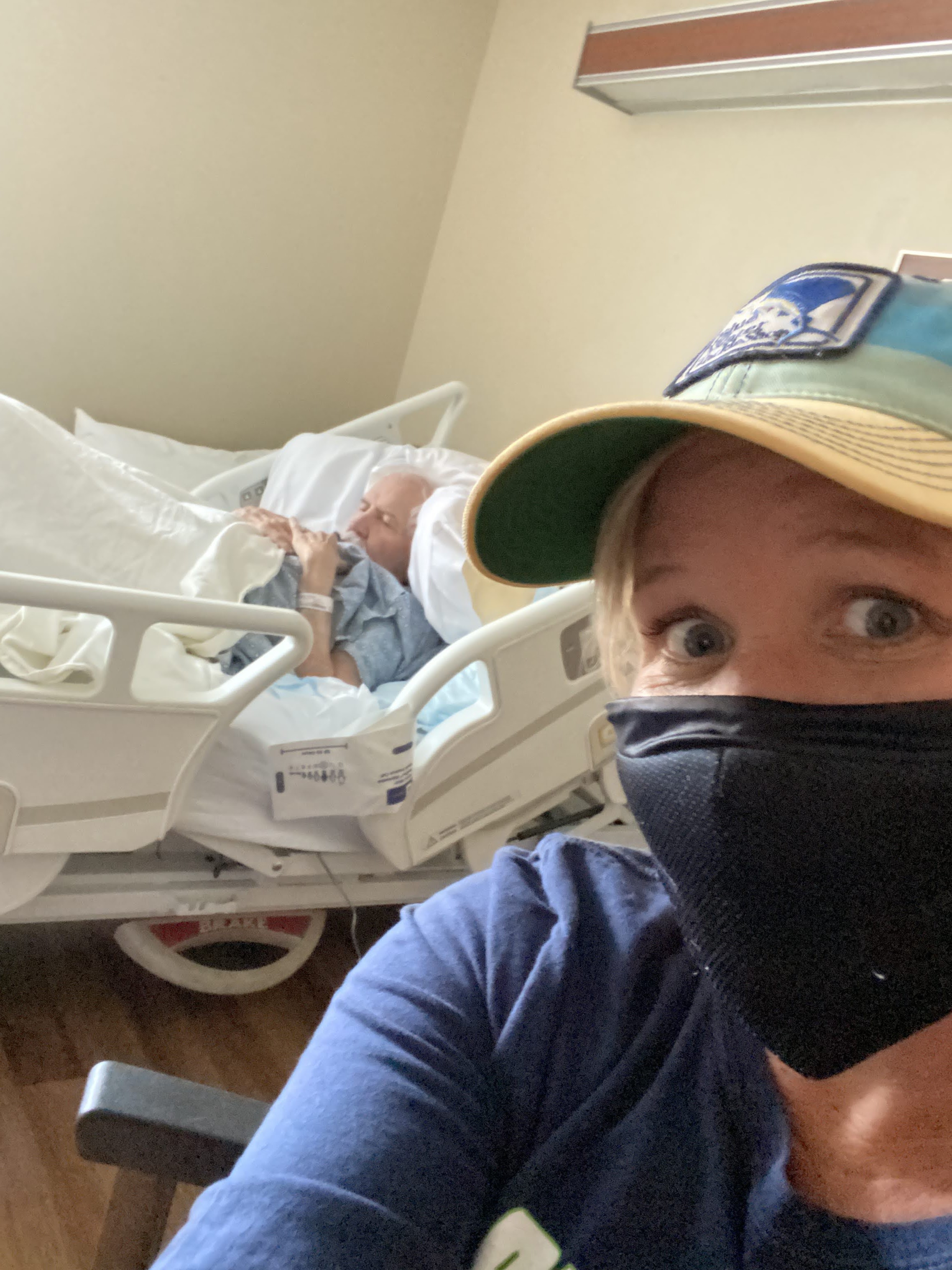
No one enjoys taking photos during a difficult time. It isn’t fun to experience the first time around, so you don’t relish going down a visual memory lane later. I feel anxious just seeing the bed, the blood pressure cuff, the bland wall, and my dad lying under a thin blanket in a snap off gown like the one I wore when my children were born. I have this one because I like sending selfies to my teenage kids instead of tediously texting an update: “I’m with Pappaw at the hospital. It’s fine. He’s sleeping. Covid regulations in effect so I have to wear a mask.” Not quite 1000 words, but they get the picture. Pun intended.
We transferred my dad to a rehab facility covered by insurance for at least twenty days. An assessment would be made at the three week mark to determine if insurance would continue coverage. We–my mom, sisters and I–did not know the system and an acquaintance recommended we contact an elder care law firm to help us navigate “the game.” We had a preliminary consultation with a lawyer on Thursday, heard he was being discharged on Friday, registered an appeal on Saturday, prayed on Sunday, and brought him home Monday. The physician believed he was well enough to move on and insurance will not pay 100% for further therapy at that point. The aversion to paying out-of-pocket costs made us move quicker than we should have because if he had stayed, then he could have been transported to either assisted living or a nursing home. Since he returned home, he would not be considered at either place without going through hospitalization again. I’m not sure if it’s strictly Covid-19 protocol related, or the open beds are just that scarce. Because he doesn’t have Long-Term Care insurance, his options were extremely limited as those available are extremely expensive.
How does Long-Term Care insurance work?
To buy a long-term care insurance policy, you fill out an application and answer health questions. The insurer may ask to see medical records and interview you by phone or face to face.
You choose the amount of coverage you want. The policies usually cap the amount paid out per day and the amount paid during your lifetime.
Once you’re approved for coverage and the policy is issued, you begin paying premiums.
Under most long-term care policies, you’re eligible for benefits when you can’t do at least two out of six “activities of daily living,” called ADLs, on your own or you suffer from dementia or other cognitive impairment.
The activities of daily living are:
- Bathing
- Caring for incontinence
- Dressing
- Eating
- Toileting (getting on or off the toilet)
- Transferring (getting in or out of a bed or a chair)
A long-term care insurance policy helps cover the costs of that care when you have a chronic medical condition, a disability or a disorder such as Alzheimer’s disease. Most policies will reimburse you for care given in a variety of places, such as:
- Your home
- A nursing home
- An assisted living facility
- An adult day care center
Considering long-term care costs is an important part of any long-range financial plan, especially in your 50s and beyond. Waiting until you need care to buy coverage isn’t an option. You won’t qualify for long-term care insurance if you already have a debilitating condition. Most people with long-term care insurance buy it in their mid-50s to mid-60s.
from Nerd Wallet

Cost of Long-Term Care Insurance
The rates you pay depend on a variety of things, including:
- Your age and health: The older you are and the more health problems you have, the more you’ll pay when you buy a policy.
- Gender: Women generally pay more than men because they live longer and have a greater chance of making long-term care insurance claims.
- Marital status: Premiums are lower for married people than for single people.
- Insurance company: Prices for the same amount of coverage will vary among insurance companies. That’s why it’s important to compare quotes from different carriers.
- Amount of coverage: You’ll pay more for richer coverage, such as higher limits on the daily and lifetime benefits, cost-of-living adjustments to protect against inflation, shorter elimination periods, and fewer restrictions on the types of care covered.
Tennessee has a higher cost of care than several neighboring states, with nursing homes averaging over $200/day, and as high as $240/day in several cities. The cost in Tennessee for home care and assisted care is approximately half as expensive, but still costly and well above what many could comfortably afford to pay, especially for an extended time period.
http://www.tennltc.com
Who Needs Long-Term Care?
According to Tennessee Long Term Care Insurance Consultants, someone turning age 65 today has about a 70 percent chance of needing some type of long-term care during their lifetime. While one-third may never need long term care, 20 percent will need it for longer than 5 years. The average length of time people need long term care services is 3 years.1
In Tennessee, the average cost for 3 years of long term care is $274,299 ($91,433 per year) at 2020 rates. That cost is projected to be $495,414 ($165,138 per year) in 2040.2
And it’s not only seniors that need long-term care. Over 35 percent of people currently receiving long term care services are between 18 and 64.3
1. 2020 U.S. Department of Health and Human Services (www.longtermcare.acl.gov), site accessed 09/30/2021
2. Cost of Care Survey 2020 (Genworth.com), site accessed 09/30/2021
3. Family Caregiver Alliance (www.caregiver.org), site accessed 09/30/2021
[Excerpt taken from http://www.ltcinsuranceconsultants.com]
Tennessee Long Term Care Partnership Program
The Tennessee Long Term Care Partnership Program is a special Tennessee program combining private long term care insurance with special access to Tennessee’s Medicaid Program (TennCare). The Tennessee Long Term Care Partnership helps Tennesseans prepare for the possibility of needing nursing home care, assisted living care or home care.
A Tennessee Long Term Care Partnership Program policy allows you to keep all, or part of your assets under the Medicaid program, if your long term care needs last longer than the benefits of your Partnership policy. Tennessee Legislature created the Tennessee Long Term Care Partnership under the auspices of several state government agencies.
Tennessee Long Term Care Partnership rates are like other policies. But the mandatory age-related inflation protection can increase the cost of insurance. So we recommend you compare Tennessee Long Term Care Partnership policies with regular LTC insurance. Because, you may find a wider range of choices better suited to your needs. This includes hybrid long term care insurance options not available under the Tennessee Long Term Care Partnership Program.

The photo above shows two kids, well, young adults at 20 and 23 years old, just married without a care in the world. The groom would be a high school teacher until becoming a licensed life insurance agent a few years later, and the bride would be a stay-at-home mother just a year later (when my oldest sister was born). They couldn’t imagine what the next 55+ years would bring, and despite his training, my insurance salesman father probably couldn’t imagine not having policies in place when he needed them the most. You just never know.
But you can try to prepare.
For your sake and for your family.

 Crossing T's and Dotting i's